
Understanding Bone Stress Injuries
 by
by 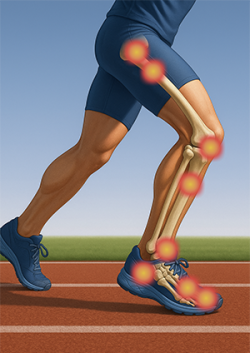
It can start as something subtle. A small ache in your foot or shin that seems to come and go during a run, then lingers a little longer afterward. Maybe you chalk it up to tight calves, worn shoes, fatigue, or the aftermath of a hard workout. But over time, that quiet ache becomes harder to ignore. Until one day, your body draws the line and you’re forced to stop.
This is often how bone stress injuries begin. Not with a dramatic pop or a sharp tear, but with an insistent whisper that turns into a shout. If you’re an athlete, runner, or someone who loves to stay active, understanding how and why these injuries occur is the first step toward both prevention and smart recovery.
What Is a Bone Stress Injury?
Bone stress injuries (BSIs) happen when a bone is overloaded by repetitive force without enough time to recover. This process starts with microscopic damage called a bone stress reaction. If the loading continues without proper recovery, it can progress into a stress fracture, which is a small and incomplete break in the bone.
While they’re most common in runners, dancers, and athletes in high-impact sports, they can happen to anyone who experiences sudden increases in training volume or intensity. Certain bones such as the tibia (shin bone), femur (thigh bone), metatarsals (midfoot bones), and pelvis (hip bone area) are more vulnerable because of how much force they absorb during weight-bearing activities.
Why It Happens: Risk Factors and Red Flags

Bone stress injuries are multifactorial, meaning they do not stem from just one cause. Some contributors come from inside the body, like nutrition or hormonal health, while others are related to external factors such as training load or footwear. Both play a role in how bones respond to stress over time.
Key risk factors include:
Previous injury
A history of bone stress injury increases the risk of recurrence, particularly if underlying causes were not addressed. Individuals with prior history of BSIs have between 2-6 times the odds of experiencing future BSIs or fractures.
Rapid training increases
Big jumps in mileage or intensity without adequate recovery place stress on the bones before they’ve had a chance to adapt.
Poor biomechanics or alignment
Repetitive loading with altered movement patterns can cause certain areas of your body to absorb more force than they should. Over time, this uneven loading can create stress points on bones like the shin, thigh, midfoot, and hip region.
Inadequate strength and control
Not having a well-rounded lower body strength program can lead to underpreparedness, as weaknesses in the hip, core, or ankle muscles may shift excess load onto bones during activity.
Low energy availability
When the body doesn’t get enough fuel to meet its energy demands, it may begin to break down bone faster than it can rebuild. This is especially relevant in athletes (male and female), where under-fueling can contribute to conditions like the Female Athlete Triad and RED-S (Relative Energy Deficiency in Sport). These syndromes involve low energy availability, hormonal disruption, and decreased bone density, all of which raise the risk of bone stress injuries and can impact long-term skeletal health if left unaddressed.
Being aware of proper nutrient intake is essential. Key nutrients like calcium, vitamin D, and protein support bone remodeling, while a balanced diet helps maintain overall energy balance. When in doubt, working with a registered dietitian or sports nutritionist can ensure your intake supports both performance and bone health.
Menstrual dysfunction in women
Irregular or absent menstrual cycles can be a sign of hormonal imbalances that negatively affect bone health.
High Risk vs Low Risk: Not All Bone Stress Injuries Are Equal
Bone stress injuries are categorized based on their location and likelihood of healing. Some bones fall into a high-risk category because they either have limited blood supply or experience high impact forces during movement.
High-risk sites:
- Femoral neck (upper part of the thigh bone near the hip joint)
- Anterior tibia (front part of the shin bone)
- Navicular bone (a small bone on the inner side of the midfoot)
- Fifth metatarsal (outer bone of the midfoot leading to the pinky toe)
- Sacrum (base of the spine above the tailbone)
- Proximal second and fifth metatarsals (closer ends of the second and fifth long foot bones)
- Sesamoids (small bones under the big toe joint that help with push-off)
- Medial malleolus (inner part of the ankle bone at the end of the tibia)
- Patella (kneecap)
These areas carry a higher chance of nonunion or complete fracture if left untreated. Treatment often includes full rest, offloading, and sometimes surgical consultation.
Low-risk sites:
- Posteromedial tibial shaft (inner side of the shin bone)
- Second and third metatarsals (long bones in the middle of the foot)
- 2nd to 4th metatarsal shafts (mid-portions of the long foot bones leading to the middle toes)
- Femoral shaft (middle portion of the thigh bone)
- Fibula (outer and thinner bone of the lower leg)
- Cuboid (outer midfoot bone near the base of the fifth toe)
- Cuneiforms (three small bones in the middle of the foot just behind the metatarsals)
- Pubic ramus (part of the pelvic bone near the groin)
- Calcaneus (heel bone)
- Ribs (bones protecting the chest cavity)
These injuries often heal well with activity modification, relative rest, and a gradual return to sport once symptoms resolve.
Getting a Clear Diagnosis

Catching a bone stress injury early can make all the difference. If you’re dealing with bone pain that gets worse with activity and better with rest, don’t shrug it off. That’s often how these injuries start.
A thorough assessment is the first step. A skilled clinician will ask detailed questions about your symptoms, training habits, and medical history, then perform a movement assessment and a hands-on exam to check for tenderness directly over the bone.
Imaging usually begins with an X-ray, but early stress injuries often don’t show up right away. If symptoms persist and suspicion is high, an MRI is typically the next step. It’s much more sensitive and can detect subtle stress reactions before they progress to a full fracture. In some cases, your provider may also use CT scans or bone scans to get a more complete picture.
Recovery: What the Research Tells Us
Healing a stress fracture is about more than just stopping activity. A comprehensive plan looks at tissue healing, movement retraining, nutrition, and sport readiness.
In the early stages, rest and offloading are key. That may mean reducing impact, switching to pool or bike training, and working on pain-free movement. Gradually, therapy shifts toward restoring strength, particularly in the hips and core. Weakness or poor motor control in these areas can cause inefficient loading patterns that increase stress on the bone.
Strength training, especially for the lower body, has been shown to reduce injury risk by improving load absorption and force distribution. Plyometrics and impact drills are reintroduced only after adequate strength and control are restored.
Nutrition matters too. Calcium and vitamin D help with bone remodeling, and making sure the body has enough fuel to support training and recovery is essential.
Physical Therapy as Part of the Plan

Physical therapy plays a central role in managing bone stress injuries. It addresses healing while supporting the athlete’s overall resilience and long-term performance.
Key goals of physical therapy include:
- Reducing pain and promoting bone healing
Load management is crucial in early phases. That may mean using crutches, a boot, or shifting to partial or non-weight-bearing activities. - Maintaining cardiovascular and muscular fitness
Low-impact cross training like swimming, cycling, or water running can help preserve fitness during recovery. - Guiding a safe return to activity
Once someone is pain-free with daily activities, a PT can guide gradual reloading through walking, then running, with close monitoring for any flare-ups. - Rebuilding strength and correcting movement patterns
Weaknesses in the hip, core, or ankle, along with running mechanics or gait issues, may contribute to excess bone loading. Addressing these helps reduce recurrence. - Preventing future injury through education and planning
Good rehab includes talking about training volume, nutrition, footwear, biomechanics, and the warning signs of a returning problem.
For high-risk injuries like femoral neck or navicular stress fractures, physical therapy should involve close coordination with physicians or surgeons to determine timelines and safe progressions. In female and younger athletes, it’s also essential to address hormonal and nutritional status as part of recovery.
Final Thoughts
Bone stress injuries may start small, but ignoring the signs can turn them into something that derails months of training. With early recognition, evidence-based rehab, and a personalized return-to-sport plan, you can rebuild stronger and smarter.
While not all stress fractures are preventable, many are manageable with better training practices:
- Listen to pain that lingers and worsens with repeated activity
- Progress training gradually and avoid large spikes in mileage or intensity
- Incorporate strength training that targets the lower body, hips, and trunk
- Fuel adequately and monitor for signs of low energy availability
- Get screened for RED-S or hormonal irregularities, especially in younger athletes
For runners and athletes returning from a bone stress injury, gait retraining and impact mechanics may also need attention. The goal is not just to heal, but to move better than before.
If you’re dealing with persistent pain during activity, or if you’ve had a history of stress fractures and want to prevent another, our team can help. Physical therapy tailored to your needs can guide you through each stage, from offloading to sport readiness.
For more information, contact Perfect Stride Physical Therapy today:
Website – https://usindiatax.in/perfectstridept/
Email – info@perfectstridept.com
Location: 32 Union Square East, Suite 215, New York, NY, 10003
Phone: (917) 494-4284
References
Boden BP, Osbahr DC. High-Risk Stress Fractures: Evaluation and Treatment. J Am Acad Orthop Surg. 2000;8(6):344-53. PMID: 11104398.
Brukner P, Bennell K. Stress Fractures in Female Athletes. Diagnosis, Management and Rehabilitation. Sports Medicine (Auckland, N.Z.). 1997;24(6):419-29. PMID: 9421865.
DiFiori JP, Benjamin HJ, Brenner J, et al. Overuse Injuries and Burnout in Youth Sports: A Position Statement From the American Medical Society for Sports Medicine. Clin J Sport Med. 2014;24(1):3-20. doi:10.1097/JSM.0000000000000060.
Hoenig T, Ackerman KE, Beck BR, et al. Bone Stress Injuries. Nature Reviews Disease Primers. 2022;8(1):26. PMID: 35484131.
Hoenig T, Hollander K, Popp KL, et al. International Delphi Consensus on Bone Stress Injuries in Athletes. British Journal of Sports Medicine. 2025;59(2):78-90. PMID: 39638438.
Moreira CA, Bilezikian JP. Stress Fractures: Concepts and Therapeutics. J Clin Endocrinol Metab. 2017;102(2):525-534. PMID: 27732325.
Morrison WB, Deely D, Fox MG, et al. ACR Appropriateness Criteria® Stress (Fatigue-Insufficiency) Fracture Including Sacrum Excluding Other Vertebrae: 2024 Update. Journal of the American College of Radiology. 2024;21(11S):S490-S503. doi:10.1016/j.jacr.2024.08.019.
Patel DS, Roth M, Kapil N. Stress Fractures: Diagnosis, Treatment, and Prevention. American Family Physician. 2011;83(1):39-46. PMID: 21888126.
Schroeder JD, Trigg SD, Capo Dosal GE. Bone Stress Injuries: Diagnosis and Management. American Family Physician. 2024;110(6):592-600. PMID: 39700362.
Tenforde AS, Kraus E, Fredericson M. Bone Stress Injuries in Runners. Phys Med Rehabil Clin N Am. 2016;27(1):139-49. PMID: 26616181.
Warden SJ, Davis IS, Fredericson M. Management and Prevention of Bone Stress Injuries in Long-Distance Runners. J Orthop Sports Phys Ther. 2014;44(10):749-65. PMID: 25103133.