Pickleball Injuries and How to Stay in the Game
 by
by 
In New York City, pickleball courts are packed– some players show up just to play and get a workout in, while others rally in competitive matches point for point. But whether you’re in it for fun or friendly competition, the aches and pains can hit just the same.
Since the pandemic, pickleball has exploded in popularity in New York City and across the country from community-run pickleball courts to CityPickle (which hosted a pop up outside our space at Union Square) to Major League Pickleball. This paddle sport, which is a mix of tennis, badminton, and table tennis, is appealing because it is a fun and sustainable workout and fosters community. Playing pickleball raises your heart rate and increases your step counts, which are markers of improving cardiorespiratory health and fitness. It can also help you achieve the CDC’s physical activity guidelines of 150 minutes of moderate to vigorous physical activity for all adults. Additionally, the social environment in pickleball is community-driven, welcoming, and encouraging. Even though the sport was originally for the over-60 crowd, it’s now common to see different generations and genders play in the same game and rally together in doubles or singles games. An older player can keep up with a younger or powerful player by controlling the ball with more precision and strategy.
Pickleball’s easy to learn gameplay, smaller court size, and slower ball speed makes pickleball more beginner-friendly and approachable compared to other racquet sports. The small court means less sprinting and places a greater focus on strategy and quicker reflexes. The simple game play and low barrier to entry allows someone brand new to racquet sports to play casually for the first time. But the skill development and shot precision separates the professional pickleball athlete from the average player.
Like any sport or physical activity, injuries happen and often stem from two patterns: underpreparation or overdoing. For most people, injuries can come from doing too much too soon, without proper strength, conditioning, technique, or training. On the other hand, more experienced or frequent players may suffer from overuse injuries caused by playing too hard too often, pushing through fatigue, and skipping recovery.
The low-impact gameplay and social community makes pickleball a sport you’ll want to play for years. But as the number of pickleballers rise, so does the need for a closer look at injury prevention and management. This article addresses the recent pickleball research on injury risks, the movement demands of pickleball, and injury prevention strategies to stay healthy on the court.

Pickleball Injury Trends
In 2024, there were an estimated 19.8 million pickleball participants in comparison to 4.8 million in 2021. The exponential increase in players has, as expected, led to a corresponding rise in injuries. According to one study, 13,690 nationally estimated pickleball-related injuries were treated in US emergency departments (ED) in 2022 compared to 611 in 2013. However, this study and similar articles on pickleball injury rates are based on emergency room data and case reports. The true number of pickleball-related injuries is likely higher because minor aches and pains (sore muscles, pulled muscles, mild strains and sprains) are not seen in the ED.
Since 2021, the demographic for the sport has changed significantly. Originally a game meant for adults older than 60 years old, the current average age is 34.8 years old. The largest player base is the 18 to 34 age group (estimated 28.8%) followed by the 35 to 54 age group (estimated 20.40%). The existing injury statistics mainly reflect the older adult population, however, and are skewed due to the higher rates that older adults use the emergency department compared to younger adults. As a younger population continues to join pickleball, there needs to be more updated research on the different age-relevant injury risks.
Despite the limitations of the data stated, it is clear what types of injuries pickleball players are experiencing on the court. Lower body muscle strains, joint sprains, fractures, and tendinopathies were the most common, followed by upper body and head-related injuries. While muscle strains and joint sprains are common to see in players of all ages, fractures, especially at the wrist and ankles, mostly affected older adults above 65 years old. That’s likely due to their reduced bone density and increased risk of falls.
Based on the literature, common pickleball-related injuries include:
- Shoulder conditions: Rotator cuff strains from repetitive overhead volleys or constantly reaching for the ball in power-focused games.
- Elbow and wrist conditions: “Pickleball elbow” (similar to tennis elbow) from the repetitive gripping and swinging motions. Fractures at the forearm from falls due to slipping, tripping, or diving for the ball.
- Hip conditions: Include glute strain, groin strains, and hamstring strains. Fractures at the hip or pelvis area due to falls.
- Knee conditions: Include meniscus injuries, patellar tendinopathy, ligament strains, and osteoarthritis flare-ups
- Achilles tendon conditions: An Achilles tendinopathy involves pain and inflammation at the Achilles tendon. An Achilles tendon rupture is a full tear of the tendon. Can be caused by the sudden running, lunging, and abrupt changes in direction.
- Ankle Sprains: Most commonly caused by an inversion or “rolling” of the ankle inwards, resulting in lateral ankle pain, swelling, and/or inflammation. To learn more about ankle sprains and proper recovery, you can read our blog about it here
- Plantar Fasciitis: Pain and inflammation of the plantar fascia (tissue at the bottom of your foot), usually occurring at the heel. Can be caused by repetitive strain on the feet.
It is important to note that this is not a comprehensive list of pickleball-related injuries and is based on information cited in the current literature and case reports.
Pickleball and Injury Management
Most pickleball injuries can be managed nonoperatively and through physical therapy. Traditional immediate injury management recommendations follow RICE (Rest, Ice, Compression, Elevation). However, research has shown mixed results on the effectiveness of RICE especially since some components can hinder healing.
A comprehensive approach to manage acute injuries is PEACE & LOVE.
PEACE summarizes recommendations for immediate new injuries: Protect, Elevate, Avoid anti-inflammatories, Compression, Educate.
- Protect is regarding 1-3 days post onset to reduce risk of reaggravation of injury, but prolonged rest is not recommended since it can lead to reduced tissue capacity and quality.
- Elevate above the heart level to reduce swelling.
- Avoid anti-inflammatories since inflammation is a part of the natural healing process.
- Compression to help reduce swelling.
- Educate to set realistic expectations to return to activity and not a magic-cure approach.
LOVE summarizes the long-term approach to rehabbing the injury: Load, Optimism, Vascularization, Exercise
- Load is to gradually increase workload on the body through progressing exercises, reps, and weight. Actively treating an injury through movement promotes repair, remodelling and builds tissue tolerance and the capacity of tendons, muscles and ligaments.
- Optimism can improve outcomes since fear avoidance and catastrophizing can increase pain and reduce function.
- Vascularization involves introducing pain-free aerobic exercise to increase blood flow to an injury to promote healing.
- Exercise is largely supported in the literature for improving soft tissue injuries. Exercise restores mobility, strength, and balance and allows people to return to function better.
A comprehensive rehab program in physical therapy guides the pickleball athlete to return to sport/performance. In the early phases, the goal is to control pain and follow PEACE and LOVE. Afterwards, your rehab should gradually progress in targeting mobility, strength, stability/coordination, and power. The goal is to make your rehab look like training to regain the foundational movements and qualities to return to function. Finally, the transition of returning to participation and sport occurs with the progression of plyometrics, running, and agility/change of direction drills to tolerate the stop and starts and sprints.
Movement Demands of Pickleball
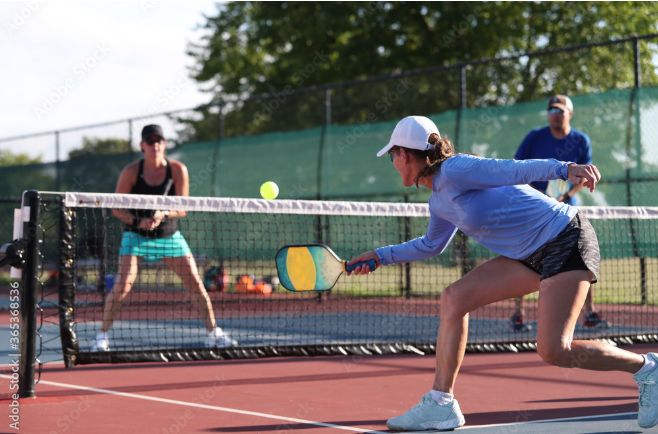
It is important to understand the movement demands of the sport to recommend injury prevention strategies. Pickleball is played mostly in the frontal plane (lateral or side-to-side movements) with some sagittal plane work (forwards/backward movements). Pickleball games typically last 15-30 minutes, and rallies (continuous back and forth shots) can last 10-30 seconds with an average of 10.8 shots per rally. The game is full of stops and go movements (deceleration and acceleration) with short bouts of work during the rallies followed by a period of rest in between rallies.
The majority of pickleball is spent in the “split step”, also known as the athletic stance or ready stance, in which feet are slightly wider than shoulder-width, hips and knees are bent, back is flat, and chest up and over your toes. This allows players to create a loaded position to move quickly in different directions and improve shot preparation and precision. The split step requires fast and reflexive footwork, strength of the calves and lower body musculature, and power/force production qualities.
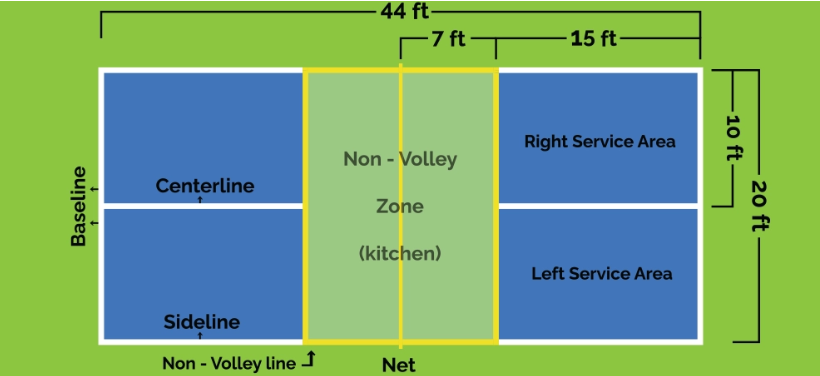
Pickleball gameplay emphasizes hand-eye coordination and strategy regarding court positioning and precision with ball placement. There is less sprinting and less force/power needed when compared to playing tennis. Putting too much force into a ball can result in a ball that goes out of bounds. Sprinting/running distance for the ball is reduced due to the small court size. However, quick footwork, pivots, lunges, and lateral movements still need to be made to react in pickleball. Acceleration and deceleration mechanics are required when sprinting towards the “kitchen” (the nonvolley zone) but abruptly stopping before the kitchen line to hit a shot. This requires increased load through lower body muscles, tendons, and joints to quickly accelerate and then decelerate to come to an immediate stop. Sometimes there is a need to backpedal or sprint behind to retrieve and return a high ball that has landed behind you. Returning these shots require increased physical agility, balance, and lower body strength, power, and coordination. This suggests a need to incorporate ballistic movements and change of direction patterns into rehab and training for the pickleball athlete.
Additionally, pickleball is commonly “played at the net”, which means players are positioned just behind the kitchen line. Playing at the net forces players to control their shots and be more accurate to ensure a nonattackable shot from their opponents. This shot at the net into your opponent’s kitchen is called a “dink” and is an important skill in this game to force an error on your opponent. It is common to settle into dinking battles at the net until an opportunity arises. Balls at the net are typically hit low, below the waist line, and so this can result in repetitive forward bending throughout the lower body and rotational movements at the upper body. This results in muscular fatigue and increased stress on the upper and lower body if not trained.
Additionally, paddle skills mirror that of tennis swing variations from the grip to the strokes. The “grip” styles in pickleball can vary depending on the player and the type of shot you’re trying to achieve. Pickleball paddles are smaller than tennis and the ball is made of durable lightweight plastic similar to a wiffleball. Too strong of a grip on the paddle for too long might result in increased repetitive strain on the wrist and forearm musculature and affect ball accuracy/control. With paddle strokes, similar to tennis, forehand and backhand strokes are commonly utilized. Additionally, overhand strokes are used for an aggressive volley and require increased mobility, strength, and power from the shoulder and upper back. This gives us insight into the upper body mechanics required for pickleball.
Pickleball and Injury Prevention
There is little published literature regarding injury prevention techniques in pickleball due to its recent rapid growth. However, the general principles of injury prevention and guidelines from other racquet sports can be applied. There is no guarantee of preventing injuries but the goal is to reduce the likelihood or intensity/severity of the injury.
- Dynamic warm up: Dynamic warm ups gradually prepare your body for the upcoming activity. The focus is to increase body temperature, increase heart rate, improve mobility or the active range of motion, improve muscular engagement, and increase cognitive focus. The priority is to warm up all major muscle groups and joints prior to pickleball participation; think shoulders, back, hips, knees, ankles. Ideally you are incorporating dynamic mobility drills and movement patterns that will commonly be used. This can look like banded activations, arm and leg swings, trunk twists, multidirectional lunges, calf raises, high knees, side shuffles, pogo hops, jump rope, and more. Follow up the active warm up with warm up drills that emphasize different strokes, dinks, and volleys to sync the eyes, hands, and timing and improve mental focus.
- Gradual progression: For those who are trying out pickleball after not having exercised for a long period of time, we recommend starting with just a few games at first. It might look like starting with an hour for 2-3 days a week at a low-intensity and adjusting after a week to see if you need more or less. Then, gradually adjust the duration, frequency, or intensity at which you are playing as you get more comfortable with the sport. What we don’t want is to do is to go from 0 minutes of exercise to 5 hours of intense pickleball; this results in an increased risk of injury from doing too much too soon without preparing your body to bridge the gap. Don’t be afraid to take rest breaks between games to prevent the repetitive impact and fatigue buildup.
- If the goal is to improve as a pickleball player, focus on the small incremental improvements to your game (serves, dinking, strokes, ball precision). Fixing everything at once is impossible and can lead to compensatory movement patterns that can increase injury risk.
- Strength and conditioning: Solely playing pickleball is not considered strength training and is not enough to consistently build muscle strength. Strength training improves the capacity of your bones, muscles, tendons, and tissues to handle load and builds the foundation for power and speed work. It improves your body’s ability to produce force and handle increased loads and demands as you play. Oftentimes, when the activity or sport demands exceeds your body’s capacity because you are underprepared an injury is more likely to happen.
- A strength training program for pickleball ideally includes the 7 fundamental movement patterns: squat, hinge, lunge, carry, upper body push, and upper body pull variation; and also frontal plane (side to side) and rotational strength. To develop your strength, it is recommended to have a consistent program that is twice per week or more. We won’t get into the details in this blog regarding strength and conditioning, but we have written a blog about it that you can check out here.
- Conditioning might be included in your strength training to help you sustain your performance especially if you are playing pickleball for a couple hours and don’t want to feel gassed in your final game of the session. An example of conditioning is interval training where you’re performing an exercise for 30 seconds (bike, jump rope, burpees, shuffles) followed by 30 seconds of rest for rounds to mimic the work:rest ratio in pickleball.
- Plyometric/ jump/ ballistic training: This is recommended as well as that is to link your strength and speed. This emphasizes quick movements and footwork to properly react in a faster rally or to even sprint a short distance for the ball. You want to make your body more efficient and prepared to help you play on court for longer. It is recommended to incorporate this into your strength routine at least twice a week to consistently develop muscle strength, coordination, and power.
- Recovery: Recovery is the process in which the body repairs itself after exercise to prepare for the next training load. Playing for several hours a day and/or for multiple intense days can result in increased muscle soreness and fatigue, especially if you’re new to the game. In this case, recovery is a priority to allow for adaptation to occur. This reduces the risk of an injury that involves overdoing because your body is able to tolerate loads better and maintain movement quality with less accumulated fatigue.
- Recovery can look like being intentional about taking a rest day and/or focusing on your sleep, stress, and nutrition during the non-playing hours. A rest day is recommended at least once a week or in between intense days if you’re a frequent player (3-5 times per week) and can include walking, gentle yoga, or any other light activity. Similar to other sports, achieving 7-9 hours of sleep is recommended to allow for the brain and body to reset itself. And proper nutrition and hydration is to allow for the body to replenish, repair, and rehydrate. By prioritizing recovery, pickleball players can stay healthy on the court and elevate their game so they enjoy pickleball for years to come.
- Court Shoes: Pickleball shoes provide increased medial-lateral (side to side) stability and support. They have good traction/grip and have a durable outsole due to the hard court surface to minimize injury risk. You may use tennis or basketball shoes if you’re in a pinch. But it is not recommended to use running shoes since running shoes promote forward motion and don’t offer lateral stability or cushioning to move in multi-directional planes.
- Paddles: Pickleball paddle designs factor in the material, weight, grit, surface texture, size, and shape, etc. The design can influence the ball accuracy, speed of your swing, and feel of the ball. If you’re a beginner, first developing your style of play and feel of the game is important before investing in a specific paddle. An advanced pickleball player typically customizes their paddles to complement their playing styles. You want to ensure that as you get more skillful in the game, the gear matches you.
Summary
Pickleball is an active, social, and healthy sport that many have come to love. Like any activity, though, there might be aches and pains. In this article, we covered ways to reduce your risk of injury with a dynamic warm up, gradual progression, training, recovery, and equipment needs; and guidelines of PEACE & LOVE to manage injuries. However, if an injury is persistent or impacting your daily life outside of pickleball, it is recommended to seek out help from a medical professional.
Want to get back on the court and get back to the game that you love?
Contact us today to start your journey to moving and feeling better:
Perfect Stride Physical Therapy
32 Union Square East, Suite 215
New York, NY, 10003
(917) 494-4284
References
Stroesser K, Mulcaster A, Andrews DM. Pickleball Participation and the Health and Well-Being of Adults—A Scoping Review. Journal of Physical Activity and Health. 2024;21(9):847-860. doi:10.1123/jpah.2024-0092
Boroumand S, Park N, Katsnelson B, et al. The perils of pickleball: A two decade analysis of upper and lower extremity injuries from America’s fastest growing sport. J Sports Sci. 2025;43(14):1378-1385. doi:10.1080/02640414.2025.2496089
Yu J, Yendluri A, Linden GS, et al. Increasing Incidence of Pickleball Injuries Presenting to US Emergency Departments: A 10-year Epidemiologic Analysis of Mechanisms and Trends. Orthop J Sports Med. 2025;13(1):23259671241305364. Published 2025 Jan 23. doi:10.1177/23259671241305364
Tajammul Pangarkar. Pickleball Statistics 2024 By Game, Players, Regions. Market.us News. Published July 23, 2024. https://www.news.market.us/pickleball-statistics/
Dubois B, Esculier JF. Soft-tissue injuries simply need PEACE and LOVE. Br J Sports Med. 2020;54(2):72-73. doi:10.1136/bjsports-2019-101253
Massillon, D., Anders, A. & Vitale, K. Diagnosis and Management of Common Musculoskeletal Injuries in the Pickleball Athlete. Curr Phys Med Rehabil Rep 13, 27 (2025). https://doi.org/10.1007/s40141-025-00499-1
A Beginner’s Guide to Buying the Best Pickleball Paddle. Paddletek Pickleball, LLC. https://www.paddletek.com/blogs/news/paddle-buyers-guide